In a recent All-In podcast, Elon Musk called AI a supersonic tsunami that will impact all white collar jobs, and of course robotics is now under the AI umbrella so that will profoundly change manual labor roles eventually too. The pace of change will depend on how rapidly AI can be trusted, thoughtfully integrated, and produce a sufficient ROI. I believe Chamath Palihapitiya said that AI is unlikely to replace all jobs, but rather slices of tasks with a person at the beginning of a task, or prompt, AI crunching vast reams of information in the middle, and a human at the backend reviewing quality, correcting, revising the prompt and analysis, and deciding next steps and usage. A great prompt to AI requires a person to make the implicit explicit, meaning a person has to direct which data is relevant and why, explain its desired usage and outcomes, linkage to policy, desired company culture, operating principles, policies, laws, etc.
Well designed AI agents are already able to perform standardized tasks and are able to consume audio and video recordings easily, combined with other key sources of data to in turn help make recommendations and/or simply take action like an employee. The capability is impressive and growing quickly, and the tools are all over the place and crying out for a coherent approach to leveraging them.
Since 2015 I’ve been blogging about organizational frameworks as a way for organizations to achieve the dual goals of executing their short term plans efficiently and effectively AND intentionally adapting. I am absolutely convinced that these two super powers must be the highest priority for all organizations. Achieving this polarity requires balancing competing energies and activities and an explicit set of guiding principles or aspirations because without it the risk of turning into a Frankenstein organization is high. Just like adults defining how the life they want and the values and impact that are important to them, I believe the same requirements hold true for organizations: you must articulate your aspirations in order to achieve them.
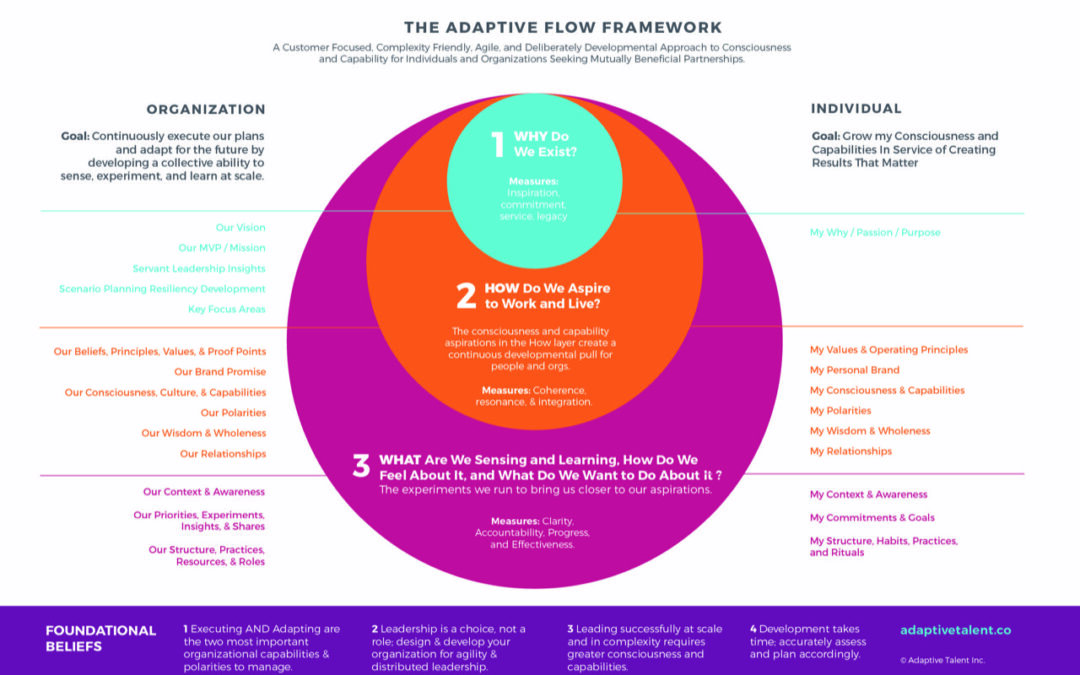
Our Adaptive Flow Framework graphically shows how similar elements for an individual map well to an organization. This required people to define (a) why the organization exists (b) how they want to operate and what they must be superb at to achieve their vision and mission and (c) the experiments they want to run to deliver those results. At the time this was to be done by people, which required focus and regular check-ins to ensure deliverables were met, experiments run well, and rapid learning was being harvested to gain a competitive advantage. This is not easy, and most organizations loosely define, integrate, and assess these things. The guiding principles, sources and displays of data, owners, and overall review and integration of those are all over the place.
I bring this up because what AI is uniquely able to do is ingest a gigantic amount of information and (hopefully accurately) present it back in a digestible way. If we want a particular experience for our customers, employees, and partners we can now prompt the AI on a framework of our aspirations to then harvest vast troves of information in combination with our employees to help us see how we’re doing. If we want our cultural values to mean anything, we can articulate explicit principles which can be used like a highly detailed prompt to suggest investments based on data. Key Performance Indicators (KPIs) combined with AI and staff input can inform leadership on performance against goals and suggest experiments to run. We can integrate those insights and suggestions across all the elements we explicitly decide to manage so that we can all take a giant step back and assess “how are we doing as an organization?”.
But now is the time to realize we need to change how executive teams lead organizations based on AI’s rapidly growing abilities. What does it mean to employ humans, and to deploy AI agents, AI powered, highly capable robots, and capital in an intentional way without demoralizing your employees, partners, and customers, or running your organization like a private equity firm? Even our core assumptions about which function “owns” which capabilities changes with these powerful tools.
My strongest advice, having lived through transformations from mainframes to today’s AI, is to spend the time now to get clear on what elements matter most to your organization (i.e., the left side of our Adaptive Flow Framework, or whatever elements you choose) in deep conversation with your employees and key collaborators. Many of these things are already defined so it’ll be more about updating, integrating them into a cohesive whole, and then honestly assessing how things are going. Experiment with your ERP, tools, and AI to begin exploring how you might unify the totality of your aspirations into your enterprise AI so that you can truly have an integrated, comprehensive assessment of how the firm is doing, and its opportunities. Tools like eightfold.ai are already assessing skills of applicants and employees to help with talent matching, so combining this with an AI powered organizational framework would be massively amazing.
We know leaders are overwhelmed and we’d love to help you find top talent, develop your leaders, and help you and your leadership team create clarity to take on this transformative work. It’s a super cool time to be alive, and now is the time to adapt.
—
Adaptive Talent is a talent consultancy designed to help organizations achieve amazing results and ongoing adaptability. Founded in 2008 and based in Vancouver, Canada we offer retained and contingent search, assessments, training, leadership coaching and development programs, and culture & organizational development consulting.